Angle of Incident
Angle of Incidence
“An image is more than just a product of perception. It manifests itself as the result of personal or collective symbolisation. Everything that passes through the gaze or before the inner eye can be understood as an image, or transformed into an image.”
Hans Belting (Anthropology of the Image, 2007)
Contemporary art is highly uncertain and responds to a range of factors which, due to their ever-changing nature, ultimately shape and alter the cultural landscape; behaviours, tastes and trends which, in turn, are linked to technological advances, scientific discoveries, economic contexts, and social and political situations. All of this is perceived as a cultural projection that is channelled through the visual realm, leading us to recognise that, in today’s world, everything is image.
Paolo Vigo’s work presents a challenge to the viewer. Through his visual art, he leads us into what is now part of our everyday lives: the transition between the real and the illusory; fictional situations projected before our eyes that speak to us of the fragility of reality, where half-truths or partial deceptions form part of the guidelines by which we navigate.
Human beings tend to both receive and generate images. It is part of our nature, and this leads to a dynamic in which visuality is called into question, for it is visuality that helps us construct a picture of reality, our ways of relating to one another, and our knowledge. Therefore, the creation of illusions is a reality. Paolo Vigo, like many others, recognises the fictions that circulate in virtual media and online communications; which is why he deliberately constructs his works to lure us into a sort of optical trap and surprise us through this process of the image being reflected or serving as a reflection of something.
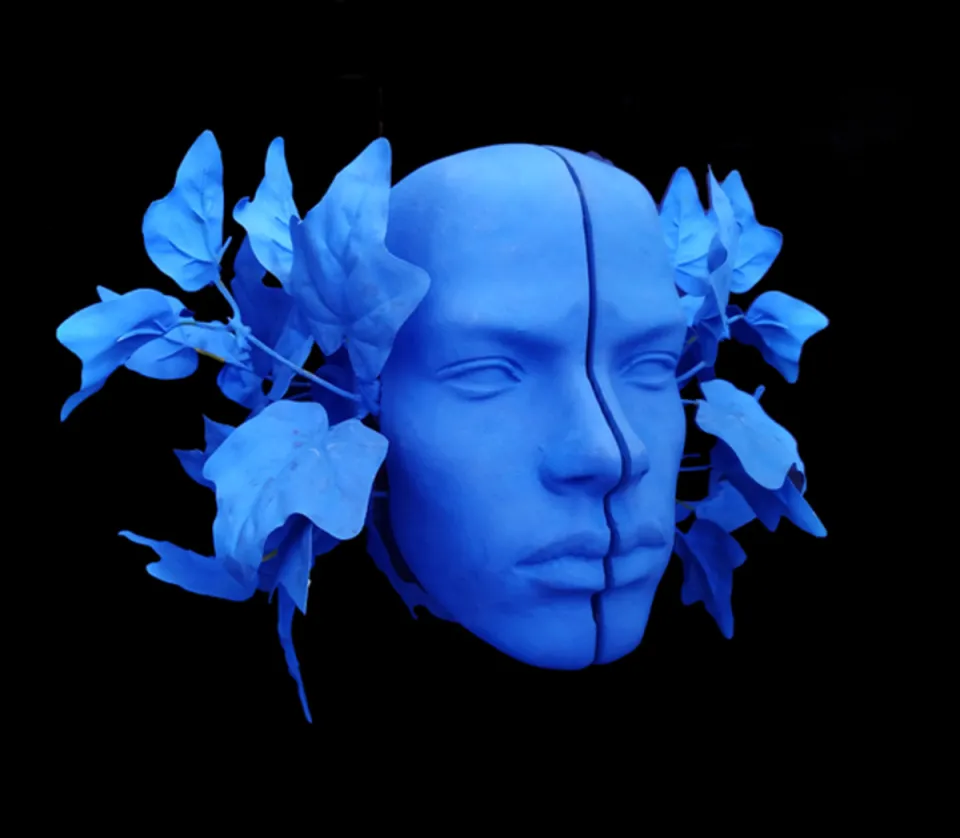
Sculptural boxes and paintings form part of this project, created using a symbolic language; each one constitutes an incomplete representation of the heads or torsos of anonymous, androgynous figures, in situations of isolation and, in some cases, in states of bodily disturbance and dissolution.
Impersonal portraits accompanied by floral elements or plants, insects, guns or gas masks turn out to be optical illusions that serve to emphasise the sense of fiction and alienation inherent in the human condition, which is shaped by education and culture.
His boxes, laden with symbolism, solemnity and mystery, contain neatly assembled sculptural works, painted in flat colours with the addition of elements such as a pistol, plants or some sort of insect. Regardless of how they may affect us, his work takes us back to Plato and the ‘Allegory of the Cave’, an allegory concerning the paths to knowledge.
On the one hand, it refers to information derived from the senses; on the other, to that derived from the world of ideas. Both are paths along which humankind constructs its knowledge: some based on situations of deception and variability, derived from the sensory realm; others built through connections with knowledge itself or ideas, in contrast to reality and in harmony with life itself. The former leads us to see only illusions—hence the metaphor of shadows; the latter brings us closer to a more solid form of knowledge, to a truer reality situated ‘outside the cave’, bathed in a light that illuminates it all.
This immutable nature of the ideas referred to by Plato is what Vigo presents to us here through art, as a situation that is being undermined in our times because we are immersed in a relative way of thinking, which is underpinned by the changing principles of ideas, one of the characteristics of postmodern culture, which is founded on the transience and fragility of time and, consequently, the short-lived nature of knowledge that extends to material productions.
It is precisely this relativity that is embedded in the practice of the liberal economy, with its fluctuating values, the fragility and transience of truth, tastes and the very validity of contemporary art—in response to a market that meanders along capricious paths of comings and goings, but largely on trends that respond to taste and fashion.
It is in these circumstances that the strategy of fiction emerges, upon which Paolo Vigo bases his proposal: art presented within a paradoxical situation in which, beyond its formal and aesthetic aims—at times verging on the realm of design—it reveals the relativity within which we currently operate, a vast, dehumanised context devoid of ethical principles—which have been devalued—in which, rather than merely analysing and criticising it, we end up accepting it as such, confronting the objectification that, as part of this culture and above all through art, seems to remain trapped within the image geared towards consumption.
It is within this framework that the symbolic nature of art—which is subject to a greater degree of relativity as it depends on how it is perceived and interpreted by others—has come to feature in this visual artist’s work, which explores themes of identity, sexuality, violence and exploitation, amongst others. It is in this exhibition that this is presented directly, complemented by paintings that serve as a kind of visual counterpoint, in which the figures appear depersonalised, silent, waiting for something to happen.
The significance of the mirror, as a symbol of the present day, is an incorporated element representing not only vanity, but also how the image is grasped and reflected, as well as the process of constructing information and knowledge to which we have already alluded in relation to Plato. ‘Angle of incidence’, as well as referring to the phenomenon of the refraction of the image, highlights the situation of the rebound and expansion of the visual idea that calls into question the degree of truth in the image, whether through spontaneous generation or as part of a process of becoming, or through creation under a certain personal or collective consciousness and intention.
Juan Peralta Berríos
Art historian and curator
March 2020